
Best Braiding Hair for Knotless Braids
If you want truly flawless knotless braids, the secret isn't just in the technique—it's in the hair you choose. The very best options are always lightweight, pre-stretched, and made from high-quality synthetic fibers like Kanekalon. These aren't just buzzwords; they're the key ingredients for a comfortable, natural-looking, and long-lasting style.
Your Guide to the Perfect Knotless Braid Hair
Let’s go beyond the basics. This guide will break down why these features are so crucial for getting that beautiful, healthy protective style you're after. We'll get into how the right hair prevents scalp stress and helps create that iconic, flat-laying look that everyone loves about knotless braids.
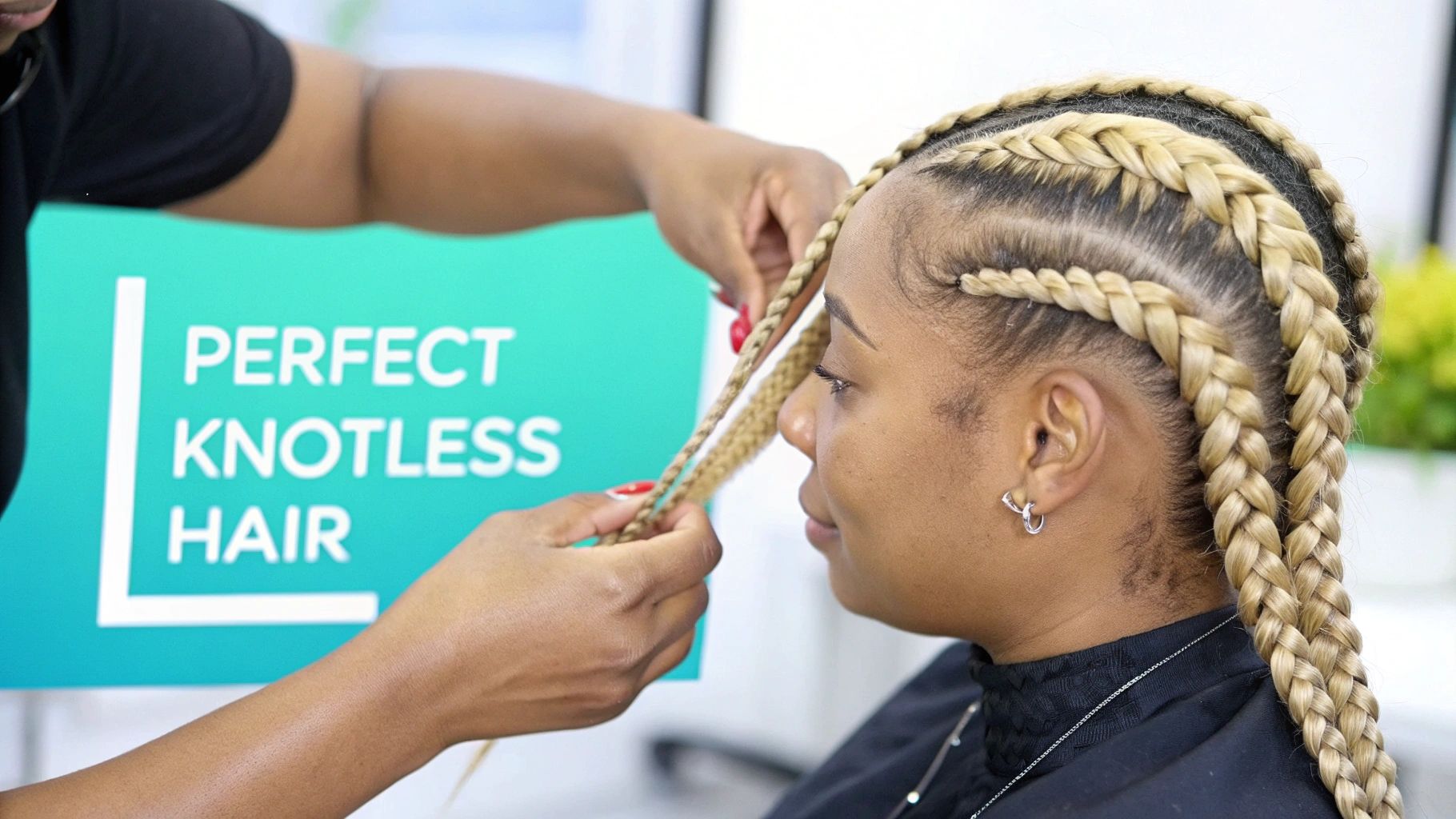
Think of this as your inside scoop for picking hair that doesn't just look incredible but actually protects your natural hair. Armed with the right knowledge, you can walk into any beauty supply store and confidently grab the best braiding hair for knotless braids every single time.
The Foundation of a Flawless Style
Ever wonder how stylists get that perfectly sleek, flat-at-the-root finish? It all comes down to the hair they use. Unlike traditional box braids that anchor with a knot, knotless braids start with your own hair, and then small pieces of extension hair are gradually fed in. This is why they're so much more comfortable and scalp-friendly, but it also means the hair has to be just right to work.
The feed-in process demands hair that is:
- Lightweight: The whole point of going knotless is to reduce strain on your scalp and follicles. Heavy hair completely defeats that purpose.
- Pre-Stretched: This is a non-negotiable. It gives the braids a natural taper at the ends, getting rid of those blunt, bulky tips. It also saves you or your stylist hours of tedious prep work.
- Slightly Textured: A little bit of texture helps the extension hair grip onto your natural hair, ensuring a secure blend that won’t slip out.
Choosing the right hair is the most critical step in the knotless braiding process. It's the difference between a style that feels heavy and slips out in two weeks and one that is comfortable, long-lasting, and truly protective.
At the end of the day, you want a style that looks and feels like it’s growing right from your scalp. Finding the perfect hair is the first step, and Elise Beauty Supply has a curated collection of professional-grade options to give your style the ideal foundation it needs.
Why Your Choice of Braiding Hair is Everything for Knotless Braids
Think of your braiding hair as the foundation for a house. If you use cheap, weak materials, the whole structure is compromised, no matter how skilled the builder is. It's the exact same story with knotless braids. The hair you choose is the single most important factor in whether you get that flawless, flat, and comfortable result you're after.
The magic of knotless braids is in the technique gently feeding in small pieces of hair to create a braid that grows seamlessly from your own. This method demands hair that's lightweight and smooth. The wrong kind of hair can completely ruin the experience. If it's heavy, coarse, or too slippery, you'll end up with bulky roots, braids that start slipping out way too soon, and a whole lot of painful tension on your scalp. This isn't just about looks; it's about protecting your natural hair and scalp.
How it Affects Your Scalp and the Life of Your Style
Knotless braids were born out of a need for a kinder, gentler alternative to traditional box braids. The whole point is to ditch that tight, bulky knot at the root, which helps spread the weight out evenly and puts way less stress on your hair follicles. But all those benefits go right out the window if you pair the technique with heavy, unmanageable extension hair.
When you use the best braiding hair for knotless braids, which is almost always a lightweight, pre-stretched synthetic fiber, it works with the technique, not against it. This is how you get a style that’s actually comfortable to wear for weeks on end and truly serves its purpose as a protective style.
This focus on scalp health isn't just a niche concern; it's a huge driver in the beauty world. The global hair braiding market is booming, expected to jump from USD 2.93 billion in 2026 to a massive USD 6.8 billion by 2035. This explosive growth is largely thanks to the popularity of styles like knotless braids. In fact, 65% of braid wearers between 18 and 25 say they prefer them specifically because they reduce tension on their edges, which can slash breakage by up to 40% compared to old-school box braids. You can learn more about these braiding market insights and see how what people want is changing the whole industry.
Why Quality Makes the Installation Process So Much Better
A great final look starts with a smooth installation. For both you and your stylist, the right hair can be a total game-changer.
Have you ever sat in the chair while your stylist struggles with tangled, rough hair? They have to work twice as hard to feed it in smoothly, which doesn't just add hours to your appointment—it creates extra friction and pulling on your natural hair.
On the other hand, high-quality, pre-stretched hair is literally designed to glide. It makes the whole process faster and more comfortable, leading to neater, more uniform braids from top to bottom. Simply put, spending a little more on the right hair from the get-go saves you time, pain, and guarantees your knotless braids will look and feel amazing.
Getting to Know Your Hair Fibers: Synthetic, Human, and Everything in Between
When you’re gearing up for a fresh set of knotless braids, the very first choice you'll make is the hair fiber. Think of it like picking the right paint for a masterpiece—the material you choose dictates the final look, how it feels, how long it lasts, and what you’ll spend. The two main options on the table are synthetic fibers and real human hair.
For most braiders, from salon pros to at-home stylists, premium synthetic hair is the hands-down winner for knotless styles. But here's the thing: not all synthetics are the same. Kanekalon is the name to know. It’s earned its reputation as the gold standard because it’s lightweight, feels soft, and looks surprisingly like natural hair.
But its popularity goes beyond just looks. Kanekalon is incredibly practical. It holds its style without any fuss and responds perfectly to hot water sealing, which is key for finishing off your braids. This blend of high performance and a friendly price tag makes it the go-to for nailing that flawless look without emptying your wallet.
Synthetic Hair: The Braider's Best Friend
Imagine a tool designed specifically for one job—that’s premium synthetic hair for knotless braiding. Its texture has just a tiny bit of coarseness, which is actually a good thing. It gives the fiber just enough grip to lock onto your natural hair during the feed-in process, preventing that annoying slippage you sometimes get with super-silky fibers.
This is exactly why you'll find it in nearly every professional salon. It’s reliable, easy to handle, and gives you the same gorgeous results, time after time.
Human Hair: The Luxe Alternative
On the other end of the spectrum, you have 100% human hair. This is your luxury option, and it brings a level of movement and styling freedom that synthetics just can't quite match. You can treat it like your own—curl it, straighten it, even color it—giving you total creative control.
Of course, that premium quality comes with a higher price and more upkeep. Human hair needs a bit more TLC to stay tangle-free and shiny, so it's an investment in both money and time. Even so, its popularity is skyrocketing.
The human hair extension market, which is a big deal for knotless braids, was valued at USD 5.36 billion in 2023 and is expected to soar to USD 13.36 billion by 2034. What's more, a whopping 92% of clients who try human hair for their knotless styles reportedly come back for more, all because of its natural feel and versatility.
Human Hair Blends: The Best of Both Worlds?
If you're intrigued by the luxury of human hair but not quite ready for the full commitment, a human hair blend is a fantastic middle ground. These packs mix real human hair with top-notch synthetic fibers. The goal is to give you some of that natural swing and softness of human hair at a much more approachable price.
To help you decide, here’s a quick comparison.
Comparing Synthetic and Human Hair for Knotless Braids
Use this direct comparison to choose the right fiber based on your budget, styling goals, and desired longevity for your knotless braids.
| Feature | Premium Synthetic (Kanekalon) | 100% Human Hair | Human Hair Blend |
|---|---|---|---|
| Price | Most affordable | Premium | Mid-range |
| Feel & Texture | Soft, lightweight, slight grip | Ultra-natural, silky, flowy | Mix of soft and silky |
| Styling | Limited (hot water set only) | Highly versatile (heat, color) | Some heat styling possible |
| Longevity | Good for a single install (4-8 weeks) | Excellent, can be reused | Better than synthetic, not as long as 100% human |
| Maintenance | Low | High (requires conditioning) | Moderate |
| Best For | Classic knotless, budget-friendly styles | Bohemian/goddess braids, long-term wear | Getting a luxury feel on a budget |
Ultimately, picking the right fiber comes down to what you value most—be it cost, styling freedom, or ease of care. Each one has its place.
This chart can help you map out your decision based on what you want to get out of your style.
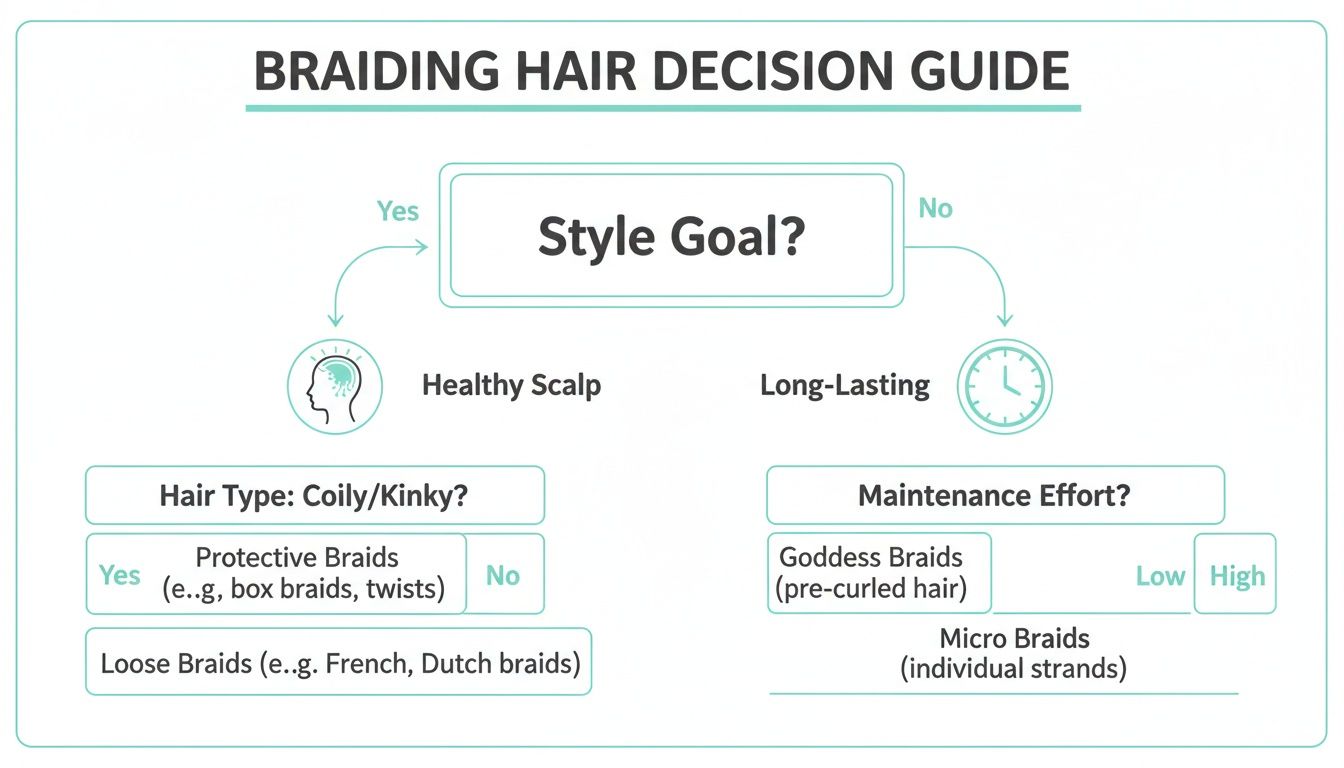
As you can see, if a happy scalp and a smooth installation are your top priorities, premium synthetic is the way to go. If you're aiming for a style that lasts and lasts, the benefits of human hair are hard to ignore. For a closer look at these differences, our guide comparing synthetic vs human hair wigs breaks it down even further. It's all about finding that perfect balance between the look you want, the budget you have, and the level of maintenance you're up for.
The Non-Negotiables for a Perfect Knotless Install
Once you've settled on the right fiber, there are a few other key features to look for that can make or break your braiding experience. These aren't just nice-to-haves; they are the details that separate a frustrating DIY session from a smooth, salon-quality result. Think of these as the magic words you want to see on the packaging.
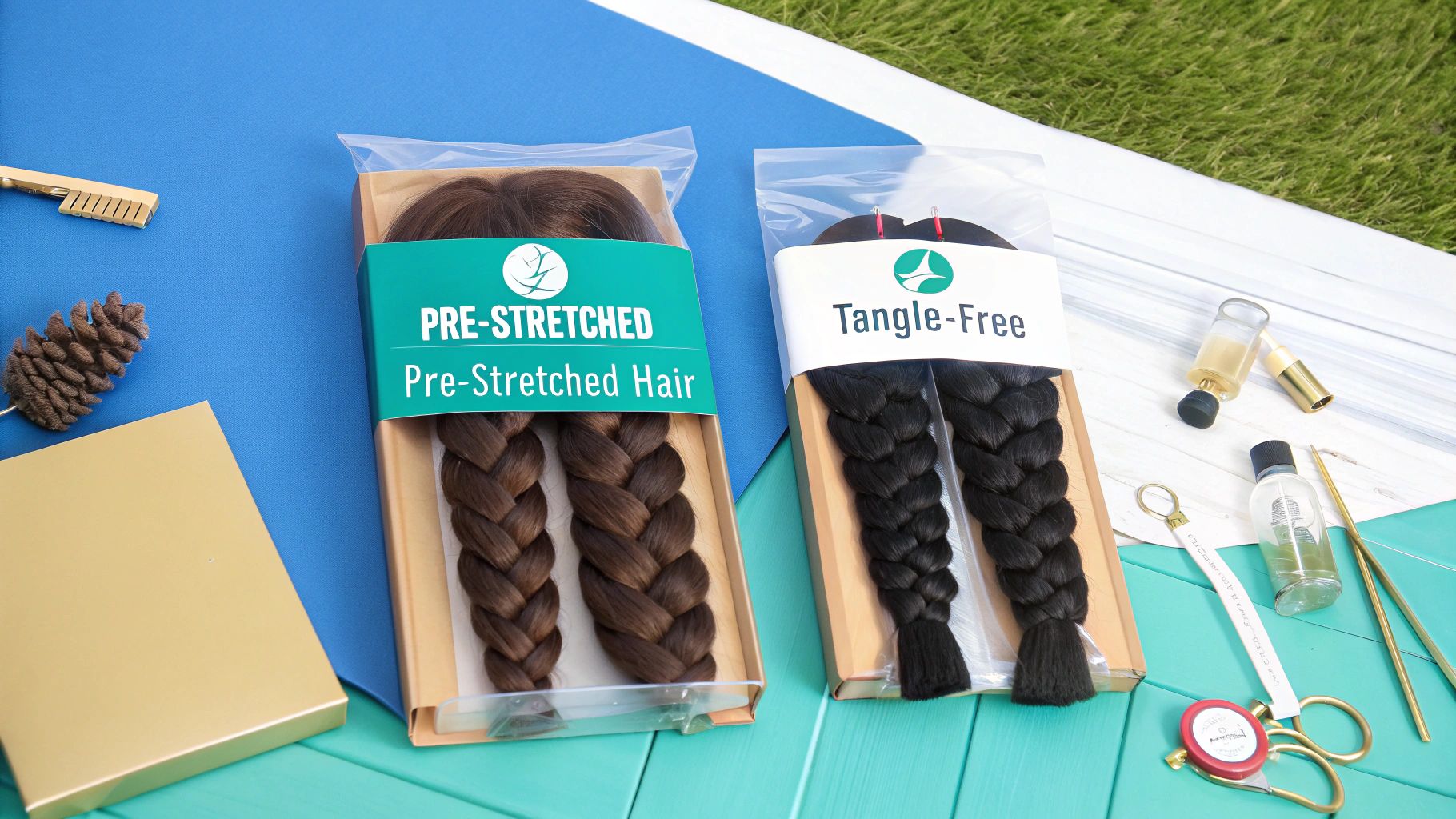
Honestly, paying attention to these features directly impacts how fast the install goes, how your scalp feels afterward, and how your braids ultimately look. Let’s get into the top three must-haves you should always look for.
Pre-Stretched Hair: The Ultimate Time-Saver
If you take away just one tip, let it be this: always choose pre-stretched hair. Back in the day, stylists (and anyone braiding at home) had to painstakingly stretch and feather every single piece of hair by hand to get those tapered, natural-looking ends. It was a tedious, time-consuming step that could easily add an hour or more to your appointment.
Pre-stretched hair eliminates all that work. It comes out of the pack perfectly prepped and ready to go, giving you a sleek, non-bulky finish every time. You can see exactly what I mean with a classic choice like the 3X X-pression Pre-Stretched Braiding Hair, which is a go-to for a reason.
Why Tangle-Free and Lightweight Matter So Much
Next up, let's talk about comfort and handling. There is nothing more aggravating than trying to separate strands of braiding hair only to have them knot up into a tangled mess. That’s why tangle-free is a feature you can't overlook—it keeps the fibers smooth and separate, making the entire process faster and way less stressful.
Just as crucial is the weight. One of the biggest reasons people love knotless braids is because they don't pull on your scalp. Using lightweight hair is absolutely key to preserving that benefit. Heavy extensions create tension and stress on your hair follicles, which is exactly what we're trying to avoid with this style.
Comfort isn't just a preference; it's driving the entire market. Knotless styles are on track to make up 45% of the U.S. braid market by 2025—a huge leap from just 20% back in 2019. Why the shift? A recent study showed that 70% of young women cited "no scalp pain" as their number one priority. This shows just how much consumer preferences are driving market trends.
Find Your Perfect Match at Elise Beauty Supply
Alright, so you’ve got the theory down. Now, let's put it into practice and get you the right hair for your vision. Think of shopping at Elise Beauty Supply as walking into a braider's paradise everything you need is right here.
Choosing your products shouldn't be a shot in the dark. We've specifically stocked our online store with high-quality, installation-friendly hair that works for seasoned pros and DIY braiders alike. You'll quickly notice that the best braiding hair for knotless braids is easy to find, with clear descriptions calling out must-have features like "pre-stretched" and "tangle-free."
This is all about making your life easier. Quality hair means less time spent prepping and more time bringing your style to life, with everything you need delivered right to your door.
Your Simple Shopping Checklist
To narrow things down, start by picturing your final look. Do you want something sleek and classic? Or are you dreaming of voluminous, textured braids? Knowing the answer will point you straight to the right product.
Here’s a quick guide to help you decide:
-
For Texture and Finish: If you’re after that silky, bone-straight finish, stick with the classic Kanekalon textures. For softer, fuller styles like goddess or bohemian braids, you’ll want to explore options with deep wave or body wave patterns mixed in.
-
For Color Matching: The best way to get a perfect match is to check out product photos on your screen in natural daylight. Seriously, hold a piece of your own hair right up to the monitor to see how the tones compare. This is especially helpful for telling the difference between similar shades like 1B (off-black) and 2 (dark brown).
Pro Tip: When in doubt, it’s usually better to go a tiny bit darker with your extensions. A slightly darker root creates a natural shadow, while hair that's too light can look obvious and less blended.
Calculating How Much Hair to Buy
"How many packs do I need?" It's the number one question we get. Nothing's worse than running out of hair halfway through an install, but there’s a simple way to avoid it.
For standard medium-sized, mid-back length knotless braids, 5-7 packs is almost always the magic number.
If you’re planning on smaller braids or want a style that’s waist-length or longer, you'll want to grab 8-10 packs. It’s always a good idea to buy one more pack than you think you’ll need—just in case. That little bit of insurance saves you from a last-minute panic run to the store.
Your Top Knotless Braid Questions, Answered
Alright, so you've got the basics down. But even the most prepared braiders have a few lingering questions before they start. It's totally normal. Getting these last few details sorted out is what separates a good braid-down from a great one.
Let's run through some of the most common questions stylists get asked all the time. Think of this as your final pre-braid huddle to make sure you're feeling 100% confident.
How Many Packs of Hair Should I Actually Buy?
This is the big one, right? The answer really boils down to two things: the size and length of the braids you're dreaming of. Thankfully, there’s a pretty reliable rule of thumb to follow.
For a classic set of medium-sized, mid-back knotless braids, you’ll want to grab 5-7 packs of pre-stretched hair. Now, if you're aiming for something more intricate like smaller box braids, or you want that dramatic waist-length look, it's smart to bump that number up to 8-10 packs.
Pro Tip: Always, always buy one more pack than you think you need. Trust me on this. There’s nothing worse than the panic of running out of hair mid-installation. It’s so much better to have a little extra stashed away than to have to stop everything for an emergency hair run.
Can I Use Hot Water to Seal the Ends?
Yes, absolutely! This is the go-to method for a reason. Most top-tier synthetic fibers, particularly the Kanekalon hair everyone loves, are made specifically for hot water setting. It's how the pros get that perfect, sealed finish.
When you dip the ends in hot water, it gently melts the fibers just enough to fuse them together. This simple step is the key to preventing unraveling and keeping your braids looking sharp and clean for weeks. Just make sure to glance at the packaging—you're looking for the words "Hot Water Set Friendly."
Is Human Hair Actually Better for Knotless Braids?
That's a great question, and the honest answer is: it depends on what you value most. Human hair is fantastic for its incredibly natural look and the ability to use heat stylers, but it's also a bigger investment and requires more careful maintenance to keep it from tangling.
For knotless braids specifically, high-quality synthetic hair is still the reigning champion. It’s lightweight, budget-friendly, holds its style with minimal fuss, and comes in an endless variety of colors. For this particular style, synthetic hair truly offers the best all-around experience.
Ready to bring your knotless braid vision to life? Elise Beauty Supply has everything you need, from premium pre-stretched synthetic fibers to luxurious human hair blends. Shop our full collection of professional-grade braiding hair today.